

Cinderella’s musical theatre history dates back to the early days of television when TV adaptations of musicals were very common. In 1955, after NBC’s successful broadcast of Peter Pan, starring Mary Martin, the CBS network was looking for more family-oriented musical projects and approached Richard Rodgers and Oscar Hammerstein II.
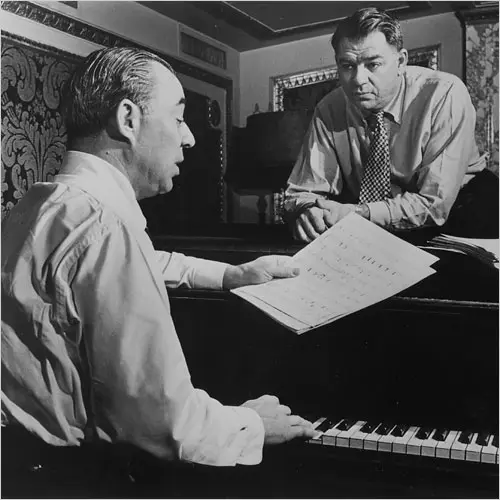
They then brought on CBS executive Richard Levine to write an original musical expressly for television, rather than merely adapting an existing one to the special television format. It was considered a novel idea at the time and the only musical Rodgers and Hammerstein ever wrote for television.
The story is derived from the fairy tale Cinderella, particularly the French version Cendrillon ou la petite pantoufle de verre (1697), by Charles Perrault. The story concerns a young woman forced into a life of servitude by her cruel stepmother. She dreams of a better life, and, with the help of her Fairy Godmother, Cinderella is transformed into an elegant young lady and is able to attend the ball to meet her Prince. In the Rogers and Hammerstein version, however, she opens the prince’s eyes to the injustice in his kingdom.
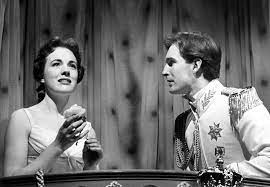
The new book also introduced several new characters and a sympathetic stepsister, and the score features several additional Rodgers and Hammerstein songs.
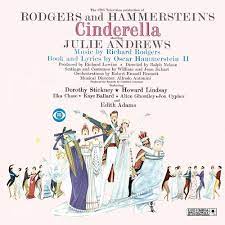
The show originally broadcast live in color on CBS on March 31, 1957, starred Julie Andrews, and was viewed by 107 million people – about 60% of the country’s population at the time. Years later, it was remade twice for television: Once in 1965 starring Lesley Ann Warren and Stuart Damon, and in 1997. Both remakes added songs from other Richard Rodgers musicals.
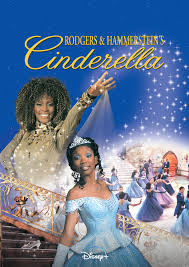
Most familiar to current generations is the 1997 television remake that was adapted by Robert L. Freedman and directed by Robert Iscove, with choreography by Rob Marshall. Produced by Whitney Houston and Debra Martin Chase for Walt Disney Television, it aired November 2, 1997, and was available on VHS/DVD thereafter. Over 60 million people viewed the broadcast and today can be streamed from various Walt Disney online media platforms.
The racially diverse cast included Brandy Norwood as Cinderella, Whitney Houston as Cinderella’s fairy godmother, Bernadette Peters as Cinderella’s stepmother, Paolo Montalban as the prince, Whoopi Goldberg as the queen, Victor Garber as the king, and Jason Alexander as the herald Lionel.
Several songs were added, including “Falling in Love with Love” from the musical The Boys from Syracuse, sung by the Stepmother; “The Sweetest Sounds” from the musical No Strings, sung by Cinderella and the Prince; and “There’s Music in You”, written for the 1953 film Main Street to Broadway, sung as the finale by the Fairy Godmother.
While various stage versions of the musical were produced beginning in 1958, the show did not open on Broadway until 2013 at the Broadway Theatre.
The show introduced a brand-new book from librettist Douglas Carter Beane, and added several new characters and expanded the world of the original. In addition to its contemporary feel, the show includes two new songs, “Me, Who Am I?” and “He Was Tall,” along with “Loneliness of Evening” and “There’s Music in You” from earlier versions.
The original Broadway cast included Laura Osnes in the title role, Santino Fontana as the Prince, and Victoria Clark as the crazy Maria/the Fairy Godmother. That production was nominated for nine Tony Awards, winning one for costume design.

In September 2014, Lesley Ann Warren joined the cast at the curtain call to honor the 50th anniversary release of her 1965 television version. The show closed on Jan. 3, 2015 after 770 regular performances. National tours and international productions have since followed.
On Aug. 6-11, 2024, the Annisquam Village Players will present their take on the musical, performing nightly at 7:30 p.m. at the historic Village Hall in Annisquam.
Don’t miss it!
2024 Presenting Sponsor

2024 Stage Sponsor: